
ETFE: an Economical Alternative to Glass
by on 9th April 2011
ETFE
One of the most exciting materials in the design industry Ethylene Tetra Fluoro Ethylene (ETFE) foil has set the construction world alight with the huge range of potential applications.
 The most sought after building material of the moment, ETFE foil is a high translucency fabric which is extremely practical and economical. The inflated cushions and single ply ETFE are approximately 1% the weight of glass this means a significantly reduced amount of structural framework is required which in turn has a substantial cost benefit. As a result, ETFE is often used as an effective replacement for glazing as it transmits up to 95 per cent of natural light and weighs a fraction of the mass.
The possible uses for ETFE foil have vastly expanded since its invention for use in aeronautics 30 years ago. It has evolved dramatically as a mainstream building material, best seen on the eye-catching North West Bus Interchange at London’s Westfield Shopping Centre.
ETFE roofs are created by extruding ETFE film to create a material with high corrosion resistance and strength over a wide temperature range; it can then be used as a single ply material or engineered into air-filled cushions supported by perimeter frames.
Single Ply ETFE:
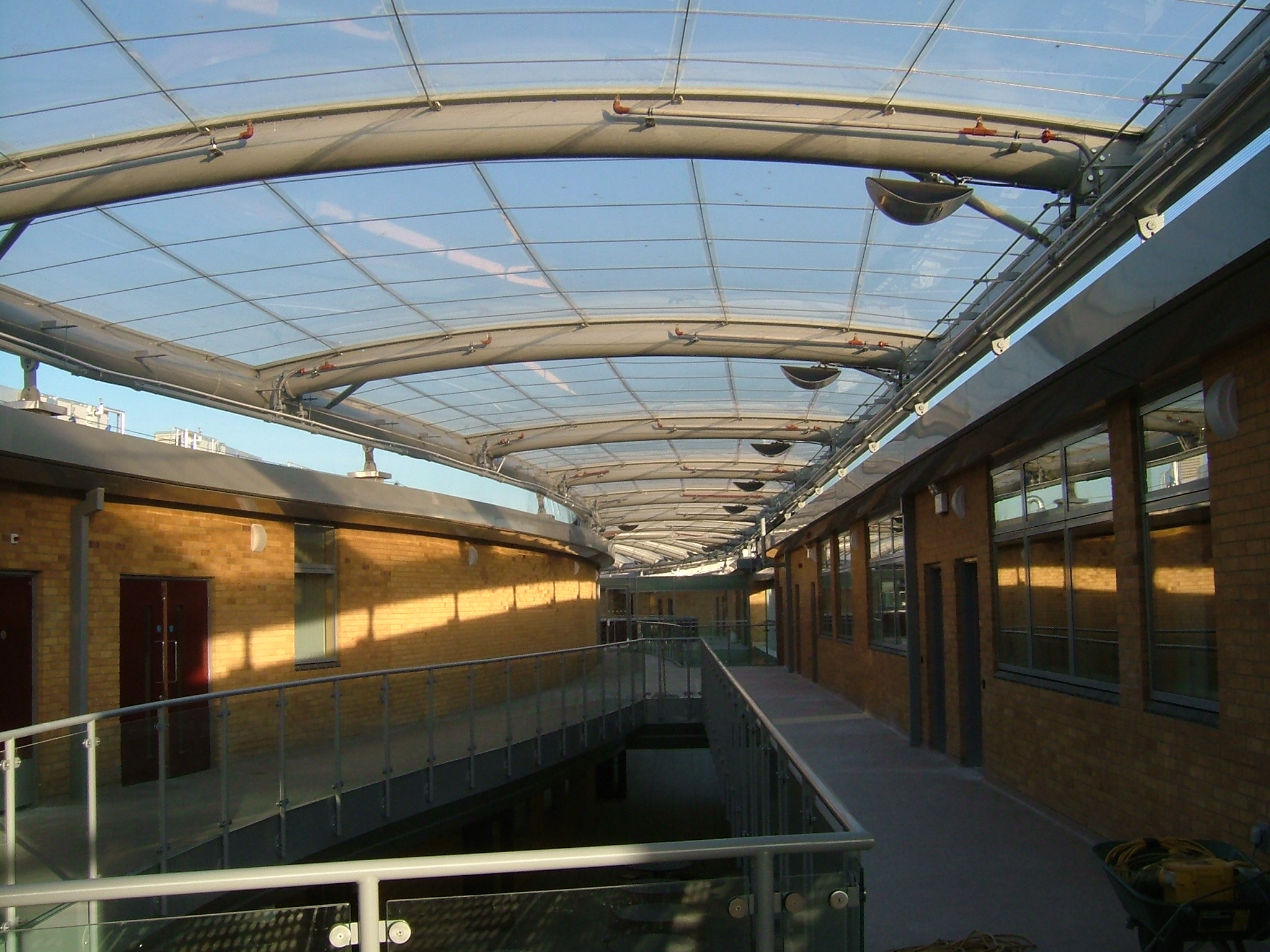 In its single ply form, ETFE foil has been used across the world. Its light weight nature, and very similar appearance to glass, means that it is frequently chosen for new buildings and old alike. An ETFE roof can be formed either by stretching the ETFE into panels as can be seen at Camellia House in Nottingham, or alternatively the membrane is supported by a cable net. Failsworth and Radclyffe schools both adopt this method in order to achieve large spans without intermediate steelwork.
Single ply ETFE provides minimal insulation but maximum light, so tends to be used to create inside/outside areas. For this purpose it has frequently been installed in schools all over the country to provide rain protection to street areas and external teaching spaces.
ETFE Cushions:
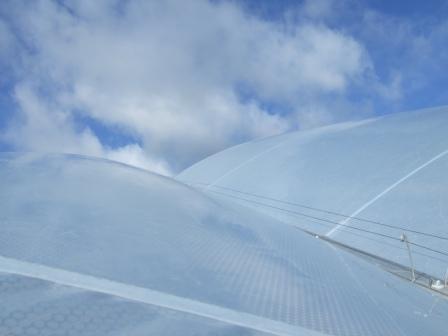 As an alternative, ETFE foil can be used to form ETFE cushions. Using inflation units the ETFE cushions provide a lightweight and insulated roof installation and can be manufactured to any shape or size, only limited by local wind or snow loadings.
As well as being a low flammability material, the ETFE foil is also self-extinguishing which means it is a good option when health and fire safety is a specific concern, for example New Cavendish Street uses a hot wire system to control smoke in the event of a fire.
The foil itself can also be engineered to help control and adapt to solar glare, as seen at the North Swindon School. Here the foil is printed (or fritted) with a pattern to provide glare reduction. Alternatively, by adding additional layers of ETFE foil to a cushion, light transmission and solar gain can be controlled. Multi-layer ETFE cushions can also be constructed. These incorporate movable layers and intelligent (offset) printing. By alternatively pressurising individual chambers within the cushion, we can achieve maximum shading and reduce shading when required. Essentially this means that it is possible to create a building skin which is reactive to its environment.
A glimpse of the exciting future ETFE offers is the Allianz Arena football stadium in Munich, where the inflated cushions are lit internally with LED lighting to make them glow varying colours. Other major projects around the globe include the stunning Water Cube Olympic arena in Beijing, built specifically for the 2008 Olympic Games and the Eden Project in Cornwall, which was the first UK structure to use ETFE cushions.
With a lifespan of more than 30 years ETFE foil is unaffected by UV light, environmental weathering and pollution and does not become brittle or discoloured over time, ensuring it is a building material here for the long term. Exciting times lie ahead with ETFE foil as ETFE increasingly becomes a vital material in the construction industry.

Other posts by Architen Landrell